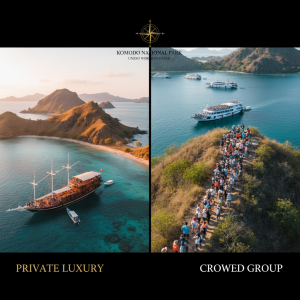
Updated: May 2026
Phinisi vs Yacht: Best Luxury Liveaboard for a Komodo Tour
- Authenticity: It offers a culturally immersive experience, reflecting the maritime heritage of the archipelago.
- Space & Comfort: The wide-beam design provides expansive decks and larger suites than a comparable monohull yacht.
- Stability: Its dual-masted structure and solid ironwood hull ensure a smooth, stable journey through the islands.
The air is thick with the scent of dried spice and salt. On the upper deck, the first light of dawn spills across the Flores Sea, igniting the volcanic cones of the Komodo archipelago in shades of bruised purple and burnt orange. Below, the gentle thrum of the engine is a steady heartbeat as we glide through water the color of polished jade. This is the essential rhythm of exploring Komodo National Park, a cadence where the vessel is not merely transport, but an integral part of the narrative. For years, I’ve navigated these waters on various crafts, and the debate among discerning travelers always circles back to a single, critical choice: the soulful, handcrafted Phinisi or the sleek, high-performance superyacht? The answer, I’ve found, is woven into the very fabric of the destination itself.
The Soul of the Archipelago: Understanding the Phinisi Legacy
To call a Phinisi a “boat” is a severe understatement; it is a piece of living history, a floating testament to Indonesia’s maritime patrimony. These majestic two-masted schooners are the direct descendants of the vessels used by the Bugis and Makassarese people of South Sulawesi for centuries of trade and exploration across the Malay Archipelago. The art of their construction is so significant that it is recognized as a Masterpiece of the Oral and Intangible Heritage of Humanity by UNESCO. I once spent a week in Tana Beru, watching the Konjo boat builders work. They use no blueprints, relying instead on knowledge passed down through generations. They assemble the hull planks first, fitting the frame into the shell afterward—a technique that defies Western naval architecture. The primary materials are ironwood (kayu ulin) for the keel and teak for the decks, creating vessels of formidable strength and longevity. A 45-meter Phinisi can require over 180 cubic meters of timber and take a team of 20 craftsmen up to 24 months to complete. This heritage is the bedrock upon which the modern luxury Phinisi is built. Today’s premier vessels, like those chartered for a Komodo luxury trip, merge this ancient soul with every conceivable modern comfort. Think expansive master suites with 180-degree views, marble-clad bathrooms with rainfall showers, climate-controlled wine cellars, and professional galleys capable of producing Michelin-level cuisine thousands of miles from shore.
The Modern Superyacht: A Study in Sleek Performance
On the other side of the spectrum is the modern motor yacht—a marvel of engineering, speed, and cutting-edge technology. These are vessels designed for rapid, climate-controlled transit, often characterized by gleaming white fiberglass hulls, sharp, angular lines, and interiors by famed designers like Philippe Starck or Alberto Mancini. The appeal is undeniable. A 40-meter motor yacht can cruise comfortably at 20 knots, more than double the 8-10 knot pace of a Phinisi. This speed means you can cover vast distances, potentially seeing more anchorages in a shorter amount of time. The onboard experience is defined by technology: zero-speed stabilizers that eliminate roll at anchor, sophisticated navigation and communication systems, and a toy garage brimming with jet skis, seabobs, and eFoils. A week-long charter on a comparable luxury yacht in the Mediterranean can easily start at $150,000 and climb steeply. While there are fewer of these vessels available for charter in the remote waters of Komodo, the philosophy they represent—of speed, efficiency, and insulation from the elements—provides a stark contrast to the Phinisi. The focus is on the destination as a series of points on a map to be reached, rather than a continuous journey to be savored. The hum of the powerful twin engines is a constant reminder of the vessel’s primary purpose: to conquer distance with prejudice.
Head-to-Head: Space, Stability, and the Onboard Experience
When you place these two vessel types side-by-side in a Komodo anchorage, the practical differences become immediately apparent. The most striking is the use of space. A traditional Phinisi is built with a wide beam, often 10-11 meters on a 50-meter vessel, compared to the 8-9 meter beam of a similar-length motor yacht. This extra width doesn’t just sound like a small difference; it translates into a staggering increase in livable area. Deck space is vast and multi-leveled, offering numerous private nooks for sunbathing, shaded lounges for afternoon reading, and expansive al fresco dining areas. Cabins are often larger, with higher ceilings, feeling more like floating hotel suites than compact marine quarters. Stability is another key differentiator. The Phinisi’s broad hull, heavy ironwood construction, and the ballasting effect of its two masts give it an inherent, gentle stability. It moves with the sea, not against it, resulting in a more comfortable experience, particularly for guests sensitive to motion. While a yacht’s electronic stabilizers are effective at anchor, the Phinisi’s fundamental design provides a superior platform under sail or slow cruise. The experiential difference is profound. Aboard a Phinisi, you are connected to the environment. You hear the wind in the rigging, you feel the grain of the teak underfoot, you watch the 12-person Indonesian crew expertly manage the sails. It is a slower, more deliberate, and ultimately more immersive way to travel, which is the entire point of the best luxury liveaboard komodo tour.
Curating the Itinerary: How Your Vessel Shapes Your Journey
The choice of vessel has a direct and non-negotiable impact on the texture of your itinerary. A motor yacht’s speed suggests a trip of broad strokes—a rapid transit from the main port of Labuan Bajo to the northernmost dive sites, a quick stop at Padar Island for the iconic sunrise trek, and then a swift return. The distance from Labuan Bajo to Gili Lawa Laut, a premier northern site, is approximately 40 nautical miles. A yacht could make this run in under two hours, while a Phinisi would take a more leisurely four to five hours. But in Komodo, speed is a solution to a problem that doesn’t exist. The magic of the park lies in the small, hidden spaces between the headline attractions. A Phinisi itinerary is built around this principle of slow discovery. Its typical 9-knot cruising speed is perfectly matched to the geography, allowing you to wake in a secluded bay, enjoy a morning snorkel with manta rays at Manta Point, and then cruise for a couple of hours to a new anchorage for a sunset cocktail. Furthermore, the Phinisi’s design, often with a shallower draft than a deep-V hulled yacht, grants access to protected coves and pristine beaches that are inaccessible to other vessels. This is the insider’s advantage: finding your own private “pink beach” away from the day-trippers. The expansive deck space also becomes a platform for the journey itself—morning yoga sessions facing the sunrise, impromptu cooking classes with the chef, or a portable cinema for movies under a canopy of stars. It transforms the “in-between” time from transit to a treasured part of the experience.
The Verdict from a Veteran Traveler: Why the Phinisi Prevails in Komodo
After more than a dozen voyages through these islands, my logbook is clear. For an exploration of Komodo National Park, the Phinisi is not just the better choice; it is the only choice that feels contextually correct. Anchoring a gleaming, futuristic superyacht off the coast of Rinca Island, where 2,000-pound prehistoric dragons roam, feels like a category error. It’s an imposition on the landscape. The Phinisi, with its organic lines, timber construction, and billowing sails, feels like an extension of it. It belongs here. This is a sentiment echoed by leading travel purveyors and government bodies like Indonesia’s official tourism board, which heavily promotes the Phinisi as the authentic way to experience the nation’s marine wonders. The service and crew are another critical factor. The all-Indonesian crew on a Phinisi brings a level of local knowledge and warm, intuitive hospitality that is impossible to replicate. Your divemaster grew up in these waters; your captain knows the currents by instinct, not just by chart plotter. They share their culture with a genuine pride that elevates the entire journey from a simple vacation to a meaningful cultural exchange. The best luxury liveaboard komodo tour is one that achieves a harmony between vessel and environment, and the Phinisi is the ultimate expression of that harmony.
Quick FAQ: Your Komodo Charter Questions Answered
Is a Phinisi safe for a family with children?
Absolutely. Modern luxury Phinisis are built to stringent international safety standards (many are SOLAS-compliant) and feature high, solid railings and numerous safety features. The crews are exceptionally accommodating and experienced in hosting families, often creating custom activities like treasure hunts and junior ranger programs for younger guests.
What is the best time of year to charter a liveaboard in Komodo?
The prime season runs through the dry months, from April to November. During this period, you can expect calm seas, clear blue skies, and optimal conditions for both trekking and diving. Water visibility for diving can often exceed 30 meters, and surface conditions are generally placid, making for smooth sailing between the islands.
Can I customize my itinerary on a private charter?
Yes, 100% customization is a cornerstone of a private Komodo Phinisi charter. Before you even step aboard, you will consult with the cruise director to craft a route based entirely on your party’s interests—be it a focus on challenging drift dives, serene paddleboarding in mangrove forests, bird watching, or simply finding the most deserted beaches for relaxation. The itinerary remains flexible throughout the trip.
How much does a luxury Phinisi charter cost?
For a top-tier, all-inclusive private charter on a 6 to 7-cabin luxury Phinisi, you should budget between $8,000 and $15,000 USD per night. This rate typically includes all meals and snacks prepared by a private chef, a full crew, soft drinks, and activities like diving, snorkeling, and shore excursions, representing significant value compared to a land-based resort and day-trip model.
The choice between a Phinisi and a yacht in Komodo is ultimately a choice between observation and participation, between passing through a landscape and truly inhabiting its spirit. To sail these ancient seas on a vessel born of the same islands, to feel the history in its timbers and the culture in its crew, is to experience the destination in its purest form. The answer for the discerning traveler sails on the wind, carried on sails that have charted these waters for generations. Explore the fleet and begin designing your own private voyage with a Komodo luxury trip, where authentic Indonesian maritime heritage meets uncompromising modern comfort.